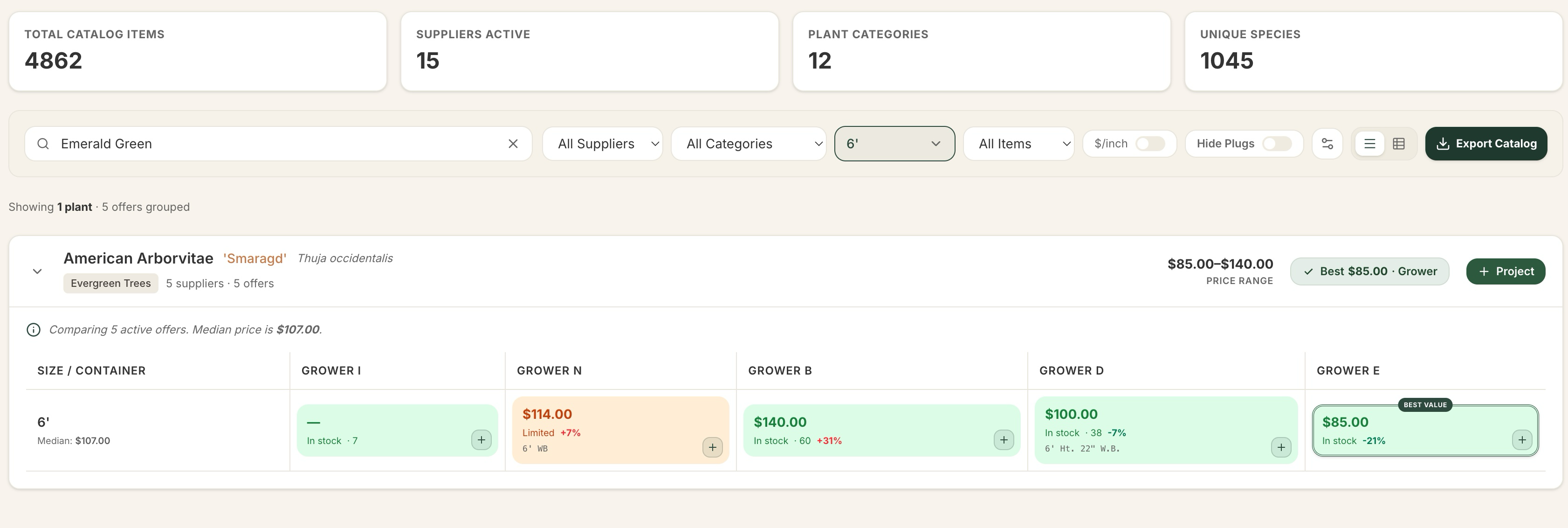
I've spent the last year reading nursery availability lists. Not skimming them, reading them, over and over, well enough to build software that reads them too.
Here's what I've learned about looking for a plant on one of these lists.
Take Emerald Green arborvitae. Here is how it appears across a stack of grower lists.
ARBORVITAE, EMERALD GREEN
Arborvitae, Emerald Green
Arborvitae:Emerald Green
Emerad
Emerald Green Arborvitae
THUJA OCCIDENTALIS Emerald Arborvitae
THUJA occ. 'Emerald'
Thua occidentalis 'Emerald'
Thua:Emerald Arbrovitea
Thuja occ Emerald Green
Thuja occ. Emerald
Thuja occidentalis 'Emerald'
Thuja occidentalis Smaragd 'Emerald Green'
Thirteen ways to list one plant. No single search term finds all of them.
Type Emerald Green
Six rows come back. Seven do not.
You miss Emerad, one dropped letter. You miss the four rows that wrote Emerald without Green: THUJA occ. 'Emerald', Thua occidentalis 'Emerald', Thuja occ. Emerald, and Thuja occidentalis 'Emerald'. You also miss THUJA OCCIDENTALIS Emerald Arborvitae and Thua:Emerald Arbrovitea for the same reason.
Type Thuja
Six rows come back. Seven do not. The five that use only the common name are gone: ARBORVITAE, EMERALD GREEN, and its variants. So are the two rows from the list that writes Thua on every line.
Type Thuja occidentalis 'Smaragd'
Nothing comes back at all.
Smaragd is the registered cultivar. Per the UT Master Gardener handbook, a cultivar name follows the scientific name and is capitalized, not italicized, and framed in single quotes. Trade designations are not part of the scientific name and carry a ™ or ® instead. Emerald Green is the trade designation. Smaragd is the cultivar.
Twelve of the thirteen rows do not contain the word Smaragd. The one that does wrote it as Smaragd 'Emerald Green', with the quotes around the trade name rather than the cultivar, so the exact registered name never matches.
Size notation does the same thing
The same plant appears at 3', 4', 5', 6', 7', and 8'. Also 6-7', 7-8', and 8-9' from growers publishing ranges. Also 10g (FP 6'+) a ten gallon container holding a plant over six feet. Also 2g (30-36"), inches instead of feet. Also 6"-9", 2yr TP, and BG, which are liners and transplants.
Matching a 6' tree across growers means reconciling exact heights against ranges, field grown against container, and finished plants against liners.
What the six foot plant costs
Four growers published a price on this plant at six feet.
| Grower | As listed | Price |
|---|---|---|
| E | 6' | $85 |
| D | 6' Ht. 22" W.B. | $100 |
| N | 6' WB | $114 |
| B | 6' | $140 |
Fifty five dollars between low and high, same plant, same height. A fifth grower carries it at six feet and publishes no price at all.
Left out of that table: a grower listing 6-7' as a range, and a ten gallon container holding a plant over six feet. Neither is the same product as a field grown six foot tree.
No errors, just no results
Search a list, get nothing, and the reasonable conclusion is that the grower does not carry it. There is no error message and no missing row. Not carrying a plant and not finding a plant look identical when you're relying on spreadsheets and PDFs alone.
A grower who has the plant, at a better price and perhaps better quality, stays invisible.
What would we find in your lists?
Nurlogix reads any grower's availability list, in whatever format it arrives, and resolves all thirteen of those variations to one plant. Search any of the names and you get every grower who has it.
The translation happens in your own private catalog, nothing enters it without your approval.
Send us three of your growers' lists and we will show you what yours look like when the names line up. You get a short video plus the full comparison in Excel and PDF, free, and the results are yours.
Let us build your first price comparison — free.
Upload up to 3 supplier lists, and we'll set up your private price comparison list free.